Healthtech Compliance Summary
-
Different regions require different compliance standards for digital healthcare software.
If you’re building for the US, you’ll need to meet HIPAA requirements. For EU markets, it’s GDPR, MDR, and potentially ISO 13485. Global products may need to consider ISO 27001 for security and privacy standards.\
-
Compliance is critical for building trust and accessing regulated markets.
Hospitals, insurers, and other healthcare partners will not work with software that doesn’t meet required standards, even if it’s functional. Compliance unlocks partnerships, funding, and user trust.\
-
Compliance affects every stage of the software development lifecycle.
From planning and architecture to deployment and post-launch maintenance, regulatory requirements influence how data is handled, stored, and protected.\
- An experienced healthtech development partner can accelerate compliance.
Choosing a tech partner who understands HIPAA, GDPR, and ISO standards means fewer delays, better architecture choices, and faster paths to market.
What’s the real cost of building a digital health product without compliance at its core?
It’s not just about fines or audits. It’s the months lost redesigning architecture for HIPAA. It’s the partnerships delayed because your platform isn’t MDR-ready. It’s the market opportunities that stay out of reach not because your product doesn’t work, but because it’s not allowed to.
For leaders building in healthcare, compliance is more than a requirement. It’s a structural part of your product and your credibility.
Still, too many healthtech initiatives approach compliance as a phase, something to address after the MVP is live, after traction, after investment. By then, it's often too late. Compliance isn’t a milestone but it’s the framework on which the product is built. When baked in early, it informs architecture, accelerates decision-making, and clears the path to market. When postponed, it quietly compounds risk at every level.
If your roadmap includes storing patient data, integrating with clinical systems, or operating in regulated markets, compliance isn’t an afterthought, it’s a product feature.
This article explores how healthtech companies can navigate regulatory complexity from day one. Not just to avoid risk, but to accelerate delivery, win stakeholder trust, and future-proof their platforms.
Why Compliance in Healthtech Software Development Can't Wait
Far too often, startups in the healthcare space treat compliance as a post-MVP concern. The reality? Compliance frameworks like HIPAA (US), GDPR (EU), MDR (EU), or ISO 13485 shape architecture, data flows, and feature scope from the outset.
For CTOs & Engineering Managers: Early non-compliance can lead to foundational decisions that must be reversed later. Regulatory compliance is not optional for covered entities and must be considered from the start. Retrofits are expensive. For CEOs: Lack of compliance readiness can kill partnerships with hospitals or insurers, or make fundraising difficult.
Regulations You Need to Know (Beyond HIPAA)
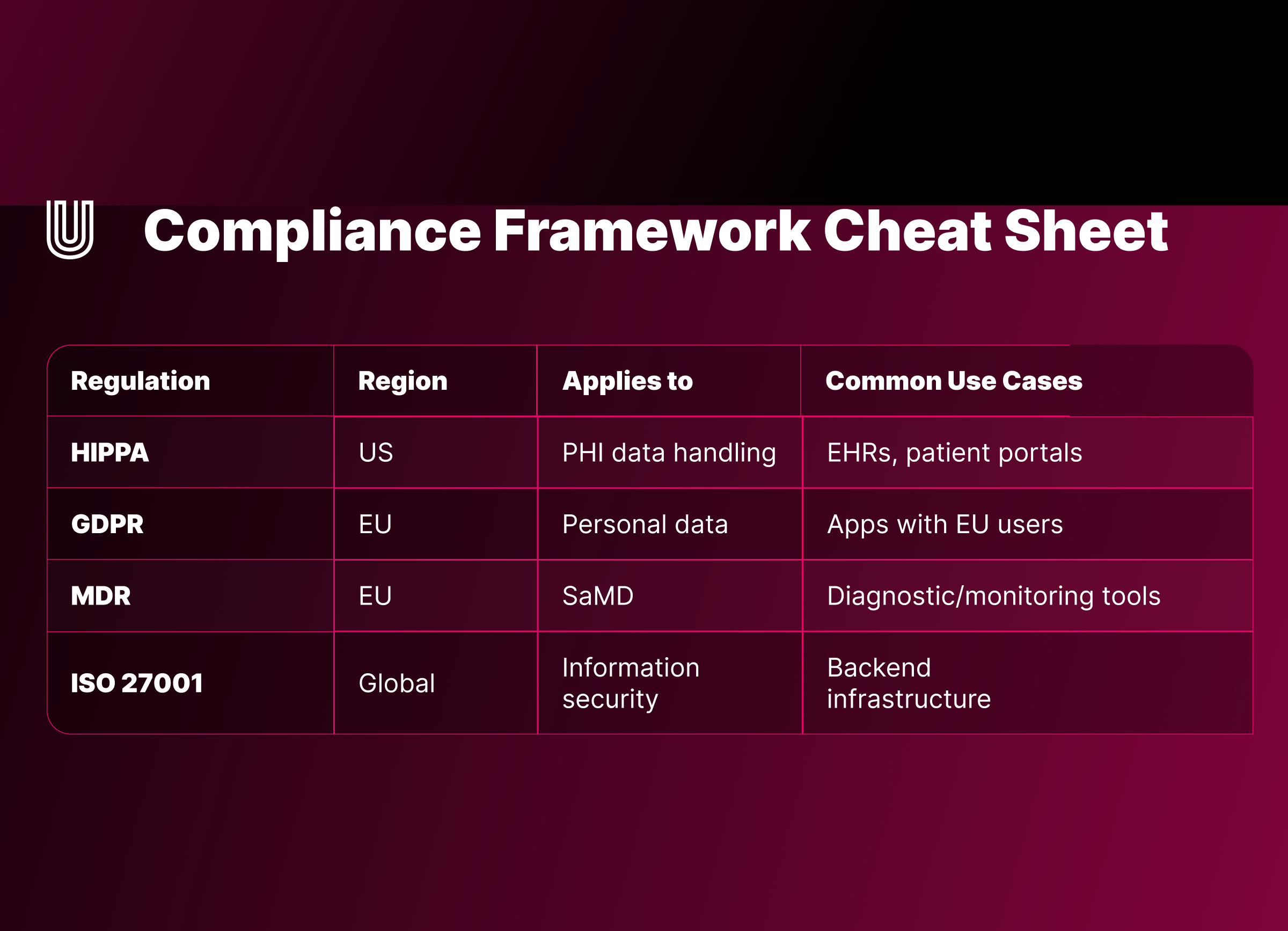
Different healthtech products fall under different rules. Here are some frameworks to be aware of:
- HIPAA: US standard for health data privacy and security. HIPAA compliance involves adhering to the Privacy Rule, Security Rule, and HIPAA Security Rule, which set standards for protecting health information, including electronic protected health information (ePHI) and regulating the use and disclosure of protected health information (PHI).
- GDPR: Data protection for EU citizens (even if your product is US-based).
- MDR: Applies to software as a medical device (SaMD) in the EU.
- ISO 13485 / ISO 27001: International standards for quality management and information security.
Organizations often use a HIPAA compliance checklist to ensure all requirements are met and to document their compliance efforts.
If you’re building solutions that analyze data, generate reports used in diagnoses, or interact with patient monitoring devices, you’re likely in regulated territory.
Stages of Regulatory Compliance in the Product Lifecycle
Let’s break down what compliance should look like at each stage of development: Integrating compliance into the development process and software development process is essential for ensuring compliance throughout the product lifecycle.
Discovery & Planning
- Identify applicable regulations based on product function and target market.
- Conduct risk classification: Is your software SaMD? Perform a thorough risk assessment at this stage to identify potential vulnerabilities and compliance gaps early in the process.
- Define data categories: Will you process PHI, PII, or biometric data?
- Engage with legal/regulatory consultants early.
Design & Architecture
- Choose compliant infrastructure (e.g., HIPAA-compliant cloud services).
- Architect for data minimization and auditability.
- Build role-based access controls and data encryption from the ground up, ensuring that administrative safeguards and technical safeguards are implemented to comply with HIPAA requirements.
- Ensure that only authorized personnel have access to sensitive health data, and that proper encryption measures are in place to protect information both in transit and at rest.
MVP Development
- Include only features that can be made compliant.
- Run initial security and privacy impact assessments.
- Prepare documentation that shows intent to comply (important for future audits).
Iteration & Scaling
- Introduce automated logging, audit trails, and monitoring tools.
- Conduct regular penetration testing and compliance reviews.
- Start ISO/FDA certification processes if relevant, which require rigorous testing to validate software quality, security, and compliance before certification.
Post-Launch & Maintenance of Protected Health Information
- Maintain incident response protocols.
- Implement data retention policies.
- Stay up to date with evolving regulations (e.g., NIS2, AI Act in EU).
- Use compliance tools to automate monitoring, reporting, and documentation, ensuring ongoing compliance.
Security Incidents and Response: What You Need to Prepare For
In the healthcare industry, the stakes for data security are sky-high and fraught with card risk. In 2024, Health Insurance Portability and Accountability Act (HIPAA) fines in the healthcare industry totaled over $9.16 million, highlighting ongoing challenges in protecting patient data amid digital transformation1. Fortunately, there is a way to address this.
Incident response plan
A robust incident response plan is essential for healthcare providers and covered entities. This plan should outline clear procedures for identifying, containing, and mitigating security incidents involving protected health information (PHI) and electronic protected health information (ePHI).
Risk assessments
Regular risk assessments are a cornerstone of effective security. These assessments help healthcare organizations identify vulnerabilities in their systems and processes, allowing them to implement targeted security measures to protect sensitive patient data.
Employee trainings
Employee training is another critical layer of defense. All staff members, from clinicians to administrative personnel, must understand their role in protecting patient data and the procedures to follow in the event of a security incident. Ongoing training ensures that everyone is aware of the latest security threats and best practices.
Same security standards for all partners
Finally, healthcare organizations must ensure that their business associates including custom healthcare software developers and other third-party vendors, adhere to the same rigorous security standards. Business associate agreements should clearly define each party’s responsibilities for protecting sensitive patient information and maintaining compliance with HIPAA and other regulatory requirements.
Common Pitfalls like Data Breaches & How to Avoid Them
- Treating compliance as legal-only. It affects your tech stack, dev workflows, and UX.
- Overengineering for regulation. Not every app is a medical device; assess first. Understanding the specific compliance rules and requirements for healthcare software compliance and medical device software is essential to avoid unnecessary complexity.
- Delaying documentation. FDA and ISO audits will ask for decision records from day one.
- Choosing the wrong partners. Your dev team and infrastructure vendors must also be compliance-aware.\

How a Tech Partner Can Help with Healthcare Software Development
Working with a software development partner experienced in healthtech can be a game changer. Here’s what to look for:
- Experience with regulated projects. Ask for examples across HIPAA, MDR, or ISO standards.
- Security-first thinking. Compliance starts with infrastructure and code — not checklists.
- Process maturity. Agile doesn’t mean unstructured. Look for clear SDLC with risk and quality control gates.
- Collaboration with legal and QA. Your tech team should work in sync with compliance consultants, not in silos, and be familiar with the role of a data protection officer as well as the requirements set by health and human services.
- Commitment to patient safety. A strong tech partner prioritizes patient safety by ensuring compliance with all relevant regulations.
If you’re building software for the healthcare industry, compliance isn’t something you add but it’s something you architect for. The healthcare system relies on secure handling of medical data, electronic health records, and sensitive data to protect patient privacy and the best time to embed compliance is at the start. That means involving legal and regulatory experts, working with development teams experienced in healthtech, and treating compliance as a core part of your product strategy — not a last-minute fix.
Building compliant healthcare software isn't easy, but it's necessary. And with the right approach and the right partners, it can become your competitive edge.
1 Source: https://www.hipaajournal.com/hipaa-violation-fines/
Frequently asked questions
What are the key healthcare compliance regulations for software development?
The most common regulations include HIPAA (for health data in the US), GDPR (for data privacy in the EU), MDR (for software as a medical device in the EU), and ISO 13485 / ISO 27001 (international standards for quality and security). Each applies based on your product type, region, and how it handles personal or medical data.
Why is HIPAA compliance important in custom healthcare software?
HIPAA sets the legal standards for protecting electronic protected health information (ePHI). Non-compliance can result in heavy fines, data breaches, and loss of trust. HIPAA compliance ensures your app is safe, legal, and viable for partnerships with healthcare providers or insurers.
When should compliance be addressed during digital health product development?
Compliance should be integrated from the discovery and planning phase. Waiting until after MVP can lead to expensive reworks, delayed certifications, and security risks. Early compliance shapes architecture and reduces long-term risk.