Discovery workshops.Get it right before you start.

TWO WEEKS TO A PLAN YOU CAN BUILD ON

At the end of a discovery workshop you know exactly what to build, why, and in what order. No guessing, no rework.

Our perspective

In MedTech, getting it wrong isn't an option

  • Getting started fast is easy. Getting started right is harder. Most teams find out what they got wrong three months into the build. Discovery moves that conversation to week one.
  • In healthcare, late mistakes don't just cost money - they cost time and compliance you can't get back.
  • Discovery is where those decisions get made before they cost you.

Two engineers reviewing a discovery workshop deliverable on a laptop

10+

Years building software

100%

Senior-led projects

40+

Team members

Process

A structured discovery process for clear outcome.

  1. 01

    Kickoff

    We align on goals, stakeholders and constraints. Who needs to be in the room and what success looks like.

  2. 02

    Mapping

    We map your workflows, systems and regulatory environment. Assumptions get tested, the real picture emerges.

  3. 03

    Analysis

    We identify gaps, risks and blockers - what's missing, what won't scale, what compliance requirements will shape the build.

  4. 04

    The plan

    You walk away with wireframes, architecture recommendations and a prioritised backlog. Ready to build.

Outcome

What you walk away with

Engineer working at a desktop workstation
01

Workflow & compliance mapping

A clear picture of your current processes, where they break, and the regulatory requirements that will shape the build.

Engineer sketching architecture on a glass wall
02

Architecture recommendations

Technical direction based on your compliance requirements, existing systems and where you're heading, before any code is written.

Two engineers reviewing a backlog at a workstation
03

Prioritised backlog

A structured list of what to build, in what order, and why ready to hand straight to a development team.

Featured case study

NHS-Ready MVP for Digital Health Platform

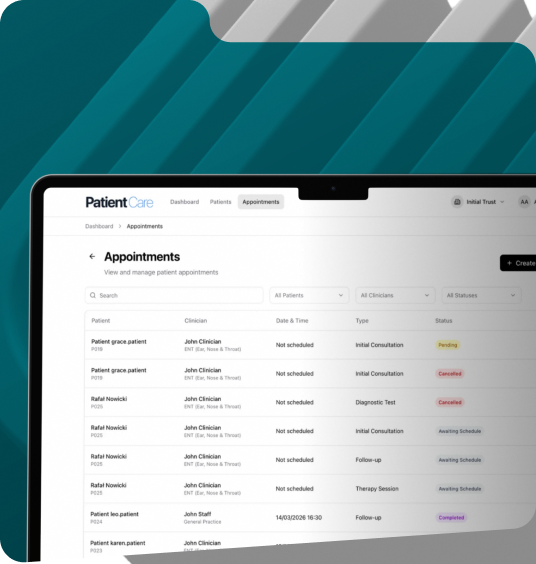
Patient appointments dashboard on a tablet

The challenge

We delivered a DSPT- and GDPR-compliant MVP in two months. Deployed on Azure, tested with stakeholders, and built so it could grow after the launch.

What we delivered

We delivered a DSPT- and GDPR-compliant MVP in two months. Deployed on Azure, tested with stakeholders, and built so it could grow after the launch.

2 months

Collaboration

2 team

Members

DSPT

Compliant

Client testimonials

Trusted by teams building mission-critical software

I think we have a very well-rounded team, and everyone seems to work well together. I’m very happy with everyone’s contributions. Each team member shines in different ways with unique contributions both to our development and our team dynamics.

Dave Maude
Dave MaudeProduct Lead, Medishout
  • ULAM LABS are a well rounded company, possessing youth and creativity, and age and experience. Highly recommended!

    PDPhilip DickensonFounder at Replant World
  • Thanks to the hard work of Konrad and his team of developers, we are confident that we are providing our institutional clients with a safe and reliable lending solution.

    SSSteve SwainCEO of Lendingblock
  • Their skill in project management is probably one of the biggest differentiators between them and their competitors. They’re great.

    ZBZank BennettCEO, Bennett Data Science
FAQ

Questions teams ask before reaching out

  • How do you handle data governance across connected systems?
    Every connection we build respects the regulatory environment it operates in - HIPAA, GDPR, DSPT. Data governance, access control and audit trails are part of the integration design, not an afterthought.
  • Do you provide documentation and ongoing support after integration?
    Yes. Every integration ships with documentation. If you need ongoing support as systems evolve or new connections are added, we stay involved.
  • Which systems and protocols do you work with?
    EHRs, QMS platforms, lab systems, NHS infrastructure and third-party APIs. We work to established healthcare standards - HL7, FHIR, DICOM and REST, across regulated environments in the UK and EU.
  • How long does a typical integration take?
    It depends on complexity. Simple API connections can take a few weeks. Multi-system integrations in regulated environments typically take two to four months. We scope it properly during discovery before committing to a timeline.

Let's see if we're a good fit

No lengthy onboarding, no big commitment upfront. Book a call and we’ll tell you within a week if we’re the right fit.