Why AI Seems Like It Doesn’t Understand You
If you’ve ever typed a request into ChatGPT, Claude, or another AI agent and received a confusing or irrelevant answer, you’re not alone. Many founders and product leaders feel that AI “just doesn’t get it.”
Here’s why:
- No true human understanding. AI doesn’t grasp meaning the way we do; it predicts what words should come next based on training data.
- Ambiguity trips it up. A human can infer missing details; AI often needs explicit instructions.
- Context loss. If a conversation goes long or drifts, the system may lose track of important details.
This mismatch can feel similar to vibe coding an MVP: you’re moving fast, but the results aren’t always stable or scalable.
Common Reasons AI Misunderstands You
- Vague requests: “Help me with my app” gives the AI almost nothing to work with.
- Too much at once: Long, multi-part requests may confuse the model.
- Missing context: If you don’t specify your audience, goals, or constraints, AI may default to generic answers.
- Ambiguous jargon: Specialized terms may have multiple meanings (e.g. “model” could mean AI, business, or data).
Just as “vibe-coded” software often works but hides technical debt, “vibe prompts” often produce surface-level answers.
Tips for Communicating Clearly With AI Agents (When Building an App)
When you want to use AI to support your app development process, clarity is critical. Think of it like writing product requirements for your development team: the better defined they are, the smoother the build.
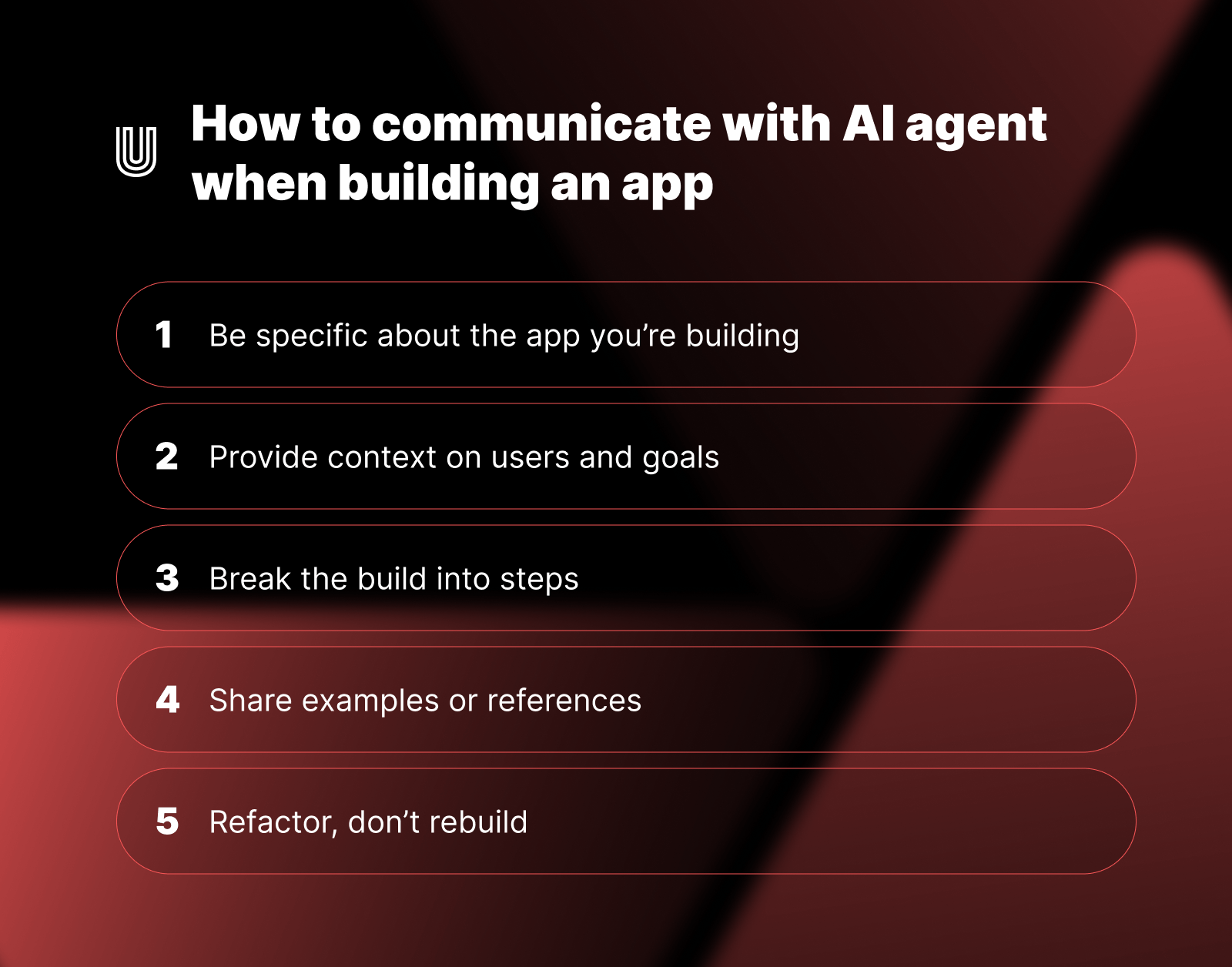
1. Be Specific About the App You’re Building
Don’t just say:
❌ “Help me code an app.”
Do say:
✅ “I’m building a mobile fitness tracker app for iOS. Help me design a clean authentication flow with email login and password reset.”
2. Provide Context on Users and Goals
Tell the AI who will use the app and what the main purpose is.
Example:
- Target audience: busy professionals
- Goal: track workouts quickly with minimal friction
- Platform: mobile-first web application
This helps the AI suggest architecture, tools, or features that make sense for your use case.
3. Break the Build Into Steps
Asking an AI to “code the whole app” at once won’t work well.
Instead:
- Define the feature list.
- Outline the app’s architecture (frontend, backend, infrastructure).
- Focus on one function at a time , e.g., first the login, then the dashboard, then notifications.\
4. Share Examples or References
If there’s an app you admire, mention it.
Example:
“I’d like a scheduling interface similar to Google Calendar, but simplified for mobile.”
Concrete reference points give AI clearer guardrails.
5. Refactor, Don’t rebuild
If the AI produces code that isn’t quite right, don’t rebuild from scratch. Instead, tell it:
- What worked
- What didn’t
- What should be changed
Iterating is like refactoring an MVP. Step by step, you move toward scalable, working code. We've written the whole manual about how to fix vibe coded MVP.
From Traction to Scale: AI as a Partner
Much like transitioning from a vibe-coded MVP to a production-ready product, working with AI-generated output requires a cleanup phase. AI can get you started quickly - generating code snippets, suggesting architectures, or prototyping features, but speed isn’t the same as scalability.
Here’s where experienced engineers make all the difference:
- Beyond “it works.” AI can produce code that appears functional, but without an expert’s review it’s impossible to know if the foundation is strong enough to scale.
- Knowledge of tools and frameworks. Skilled developers understand not only how to integrate AI’s suggestions but also which frameworks, libraries, and infrastructure choices align with your long-term roadmap.
- Assessing technical debt. Just as with a scrappy MVP, hidden inefficiencies pile up in AI-generated code. Cleanup by experienced developers ensures you’re not building on shaky ground.
- Strategic investment. Involving professionals early turns AI into a true accelerator - you keep the speed from the AI’s “first draft” but gain the confidence that the results are sustainable.
The real leverage comes when AI and engineers work together: AI handles the repetitive or exploratory tasks, while human expertise ensures the underlying architecture can carry your business from traction to scale.
Turning First Drafts Into Future Growth
AI can help you move faster than ever: generating prototypes, scaffolding code, and accelerating your journey to traction. But speed alone is not enough.
To scale with confidence, you need more than an app that just runs; you need an app built on solid, scalable foundations. That’s where experienced engineers make the difference: they refactor, stabilize, and future-proof what AI kickstarts.
At ULAM LABS, we help founders and scaling businesses bridge the gap between “AI-assisted first draft” and “investor-ready product.” We know the tools, the code, and the cleanup strategies that transform raw output into a platform for growth.
Let’s talk about how we can refactor, not rebuild, and turn your AI-driven MVP into a product built for the long road ahead.
Frequently asked questions
Can AI build a full app on its own?
AI can generate code, components, and even rough prototypes. But without human review, the results may hide performance issues, security risks, or technical debt. Think of it as scaffolding - useful, but not a finished building.
Why can’t I rely only on AI for app development?
Because AI doesn’t assess trade-offs, architecture quality, or long-term maintainability. It can produce something that “works,” but that doesn’t mean it’s scalable or secure. That’s where skilled engineers step in.
What’s the best way to use AI for development?
Use AI for speed: prototyping, brainstorming, writing boilerplate code, while relying on experienced developers to refactor, validate, and integrate. This combination gives you both traction and scale.
How do I know when it’s time for cleanup?
If your AI-generated or MVP-style code is showing cracks - slow performance, lack of structure, or trouble adding new features, that’s the moment to bring in experts for refactoring. Also, read our blog about the signs to give your codebase the cleanup it deserves.
Is codebase cleanup really worth the investment?
Absolutely. Code cleanup isn’t a sunk cost but a strategic investment. Refactoring now saves you from painful, expensive rebuilds later and sets a solid foundation for growth.