Kaspa has emerged as one of the most technically ambitious cryptocurrency projects, standing out for bold claims and actual performance. While many networks focus on faster transactions or greater scalability, Kaspa approaches these challenges with a protocol designed to handle both without compromise.
At its core is GHOSTDAG, a protocol that allows parallel block creation. Unlike traditional blockchains, where blocks are added one after another in a linear sequence, Kaspa enables multiple blocks to be created and confirmed simultaneously. This approach dramatically improves transaction speed and scalability while maintaining the security and decentralization expected from a proof-of-work system.
Beyond its technical edge, Kaspa is positioning itself as a platform for high-throughput applications, low-cost transactions, and tools developers can rely on.
In this article, we’ll explore how Kaspa works, its unique approach, and why it’s gaining traction among developers and investors.
What is Kaspa?
Kaspa is a proof-of-work (PoW) cryptocurrency built to address the persistent limitations of older blockchain systems: slow transaction speeds, poor scalability, and network congestion. At its foundation lies the GHOSTDAG protocol - a technology that allows Kaspa to process transactions faster while maintaining the decentralized security expected from PoW networks.
GHOSTDAG: A Shift from Linear Chains to Parallel Blocks
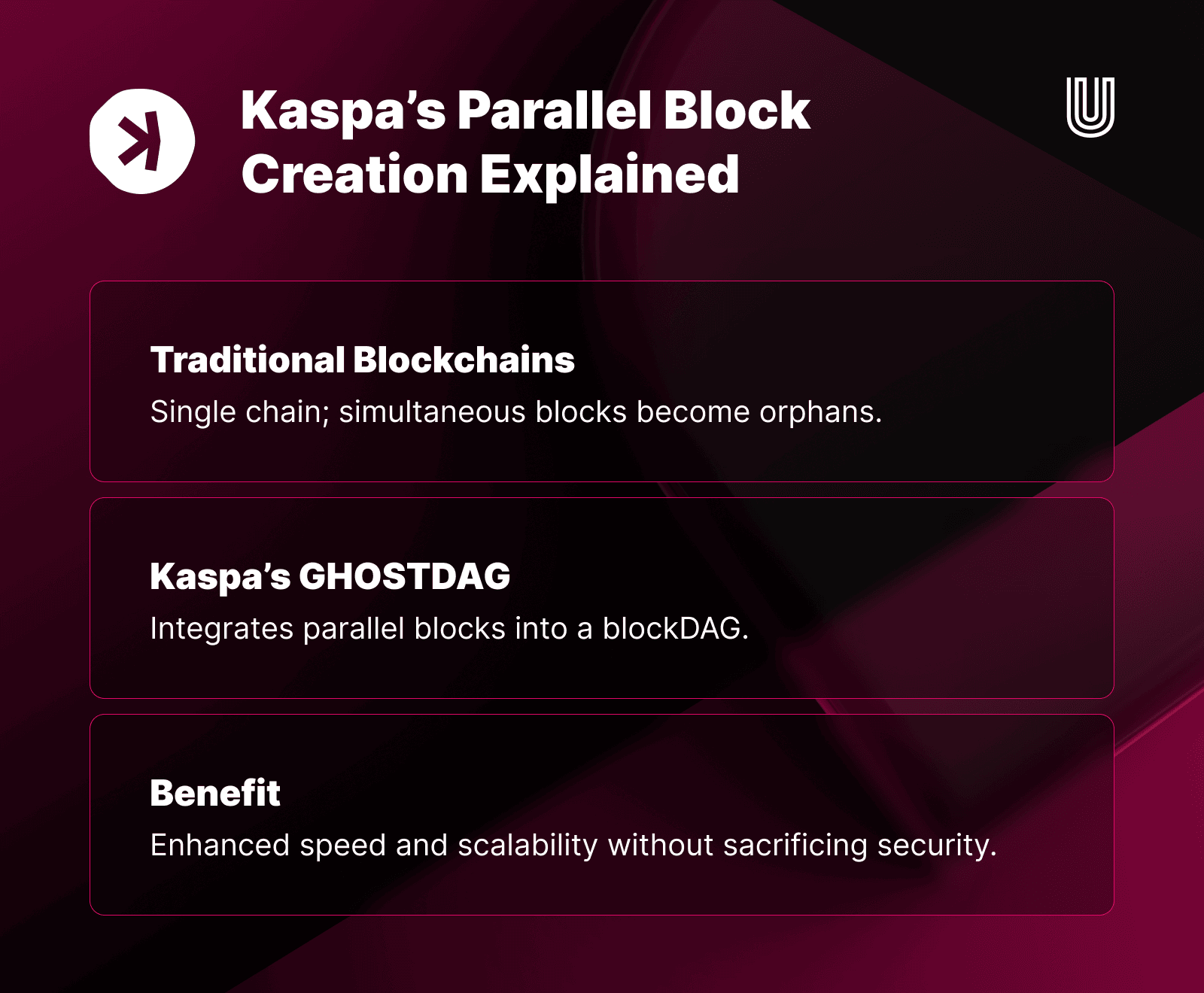
Traditional PoW blockchains, like Bitcoin, operate on a single-chain model. Each block must be added sequentially, and any simultaneous block creations are considered “orphans” and excluded from the main chain. This linear approach limits transaction throughput and creates bottlenecks during high-activity periods.
Kaspa, however, introduces GHOSTDAG (Greedy Heaviest Observed SubTree Directed Acyclic Graph). Instead of discarding simultaneously created blocks, GHOSTDAG integrates them into a larger structure known as a blockDAG (Directed Acyclic Graph). This means multiple blocks can coexist, be validated, and contribute to consensus at the same time.
In simpler terms: while traditional blockchains are like a single-lane highway prone to traffic jams, Kaspa is more like a multi-lane expressway with cars (blocks) traveling simultaneously without collisions.
Core Properties of Kaspa
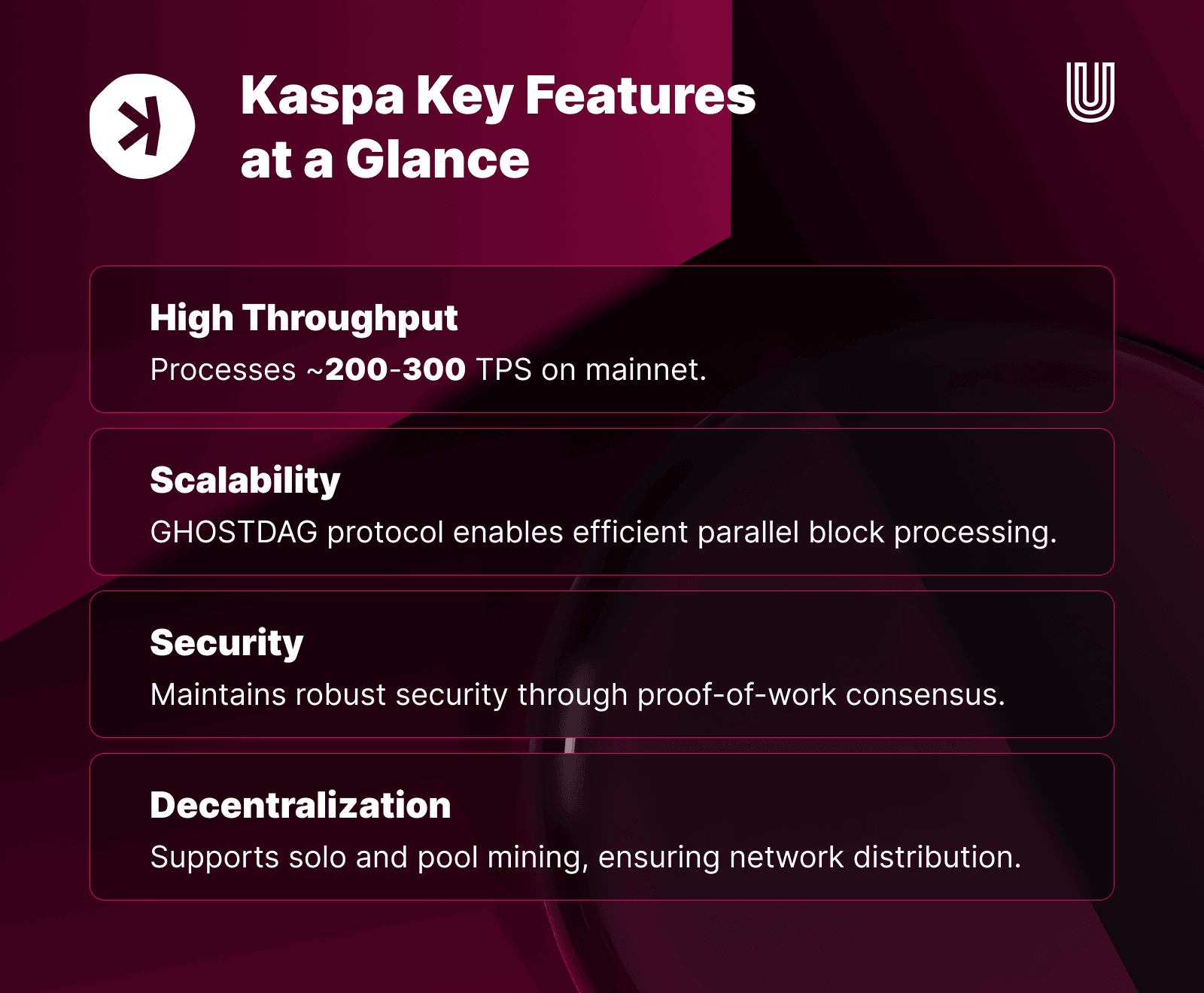
• High Throughput: Kaspa currently achieves speeds of up to 10 blocks per second, with future updates aiming for even higher block rates.
• Decentralization: Despite its high speed, Kaspa doesn’t sacrifice decentralization—a common trade-off in many high-throughput networks.
• Security: By maintaining PoW consensus and leveraging GHOSTDAG, Kaspa ensures robust network security even under heavy usage.
Kaspa’s design doesn’t just solve the problem of slow transactions—it fundamentally redefines how blocks are validated and added to a network. This efficiency makes it particularly appealing for use cases requiring high-speed, low-cost, and secure transactions.
Technical Architecture of Kaspa
Kaspa’s architecture isn’t just an incremental improvement over existing blockchain designs—it’s a fundamental shift in how transactions and consensus can coexist efficiently. At the heart of this efficiency are two key elements: the GHOSTDAG protocol and the kHeavyHash algorithm. Together, they enable Kaspa to process transactions at unprecedented speeds while maintaining decentralization and network security.
GHOSTDAG Protocol and Parallel Block Creation
In traditional proof-of-work systems, like Bitcoin, miners compete to add a single block to the chain. Blocks created simultaneously by different miners are often discarded as “orphans,” leading to wasted computational resources and reduced efficiency.
Kaspa eliminates this bottleneck. With GHOSTDAG, multiple blocks can be created and validated simultaneously. Instead of rejecting orphaned blocks, GHOSTDAG incorporates them into a blockDAG—a graph structure where parallel blocks coexist and contribute to the overall chain weight.
Why Does This Matter?
• Higher Throughput: Kaspa currently supports 10 blocks per second, with future upgrades targeting even higher rates.
• Faster Confirmations: Transactions are confirmed more rapidly since multiple blocks are processed concurrently.
• No Bottlenecks: Network congestion is significantly reduced, even during periods of high activity.
To put it simply: GHOSTDAG allows Kaspa to scale horizontally, adding capacity by expanding the number of blocks processed simultaneously rather than relying on a single chain.
%2520Comparison.png)
kHeavyHash Algorithm and Mining
While GHOSTDAG redefines consensus and block organization, kHeavyHash governs how miners participate in the Kaspa network. kHeavyHash is Kaspa’s custom hashing algorithm optimized for both efficiency and hardware compatibility.
Key Advantages of kHeavyHash:
• Energy Efficiency: kHeavyHash is less computationally intensive than traditional PoW algorithms, making Kaspa more energy-efficient.
• Hardware Flexibility: Supports both GPU mining and future mining optimizations, ensuring accessibility for a broader range of participants.
• Security Through Proof-of-Work: Despite its efficiency, kHeavyHash maintains the security guarantees of traditional proof-of-work systems.
Mining on Kaspa: Solo and Pool Mining
• Solo Mining: Independent miners can participate in securing the network and earning rewards.
• Pool Mining: Groups of miners can pool their resources for more consistent payouts.
Combined with GHOSTDAG, the kHeavyHash algorithm ensures that Kaspa remains both highly secure and scalable without compromising on decentralization.
Key Features and Advantages of Kaspa
Kaspa delivers measurable improvements in critical areas like transaction speed, scalability, and network security. These features address long-standing limitations in proof-of-work networks without relying on compromises or centralization.
Speed and Scalability
Kaspa processes transactions faster than most traditional proof-of-work systems, thanks to its parallel block creation powered by the GHOSTDAG protocol. Instead of queuing transactions in a linear chain, Kaspa allows multiple blocks to be processed and confirmed simultaneously.
• Transaction Speed: The network currently supports 10 blocks per second, with planned upgrades targeting even higher rates.
• Scalability: Kaspa’s blockDAG structure ensures that the network can handle increased traffic without becoming congested.
Unlike many other networks, Kaspa scales horizontally, adding capacity through parallel block creation rather than relying on larger blocks or layer-2 solutions.
Decentralization and Security
Security and decentralization are non-negotiable for proof-of-work networks, and Kaspa prioritizes both without compromise.
• Decentralized Mining: Kaspa supports solo mining, GPU mining, and pool mining, ensuring participation remains accessible.
• Proof-of-Work Security: The kHeavyHash algorithm ensures robust protection against attacks while maintaining computational efficiency.
• 51% Attack Resistance: Kaspa’s design minimizes the risk of 51% attacks by incorporating parallel blocks into a blockDAG structure, reducing the frequency of orphaned blocks and diminishing an attacker’s advantage (source).
• No Central Governance: The network operates without a centralized authority, relying instead on distributed consensus (source).
Kaspa’s architecture ensures that security scales alongside performance, preventing the typical trade-off seen in other proof-of-work networks (source).
This combination creates a network resistant to centralization risks while maintaining robust security and reliable performance.
Kaspa Ecosystem and Community
A thriving ecosystem is essential for any cryptocurrency to move beyond being just another speculative asset. Kaspa is steadily building an environment that supports developers, miners, and everyday users, with an active community playing a central role in driving growth and adoption.
Developer-Friendly Environment
Kaspa offers a solid foundation for building decentralized applications (dApps) and other blockchain-based solutions. Its architecture supports high throughput, low fees, and reliable performance—features that developers need to create scalable applications.
Key highlights include:
• Open-Source Codebase: Developers can access and contribute to Kaspa’s code via public repositories.
• Documentation and Resources: Comprehensive guides and technical documentation make it easier for developers to start building.
• Future Smart Contracts Support: While Kaspa currently focuses on scalability and transaction speed, there are plans to introduce smart contract capabilities in the future.
Wallet Options
Accessing and interacting with the Kaspa network is streamlined through a variety of wallet options:
• Kaspa Web Wallet: Easily accessible via browsers, offering convenience without compromising security.
• Hardware Wallets: Support for secure offline storage using devices like Tangem Wallets.
• Community-Developed Wallets: Various third-party wallets also support Kaspa, expanding accessibility.
These options cater to both casual users and serious investors looking to securely store their KAS tokens.
Community-Driven Growth
Kaspa’s community plays a crucial role in network development, adoption, and promotion. Initiatives like online forums, developer meetups, and community-driven improvement proposals keep the ecosystem vibrant and active.
• Active Forums and Social Channels: Communities on platforms like Discord, Reddit, and Telegram offer support and updates.
• Ambassador Programs: Incentivizing community members to promote Kaspa globally.
• Transparency: Regular updates from the Kaspa team keep stakeholders informed about progress and future developments.
With an open-source philosophy and an engaged community, Kaspa continues to grow its reach and relevance in the cryptocurrency sector.
Mining Kaspa: Processes and Rewards
Mining is the backbone of any proof-of-work cryptocurrency, and Kaspa introduces optimizations that make the process more efficient, accessible, and rewarding. With its unique kHeavyHash algorithm and support for various mining methods, Kaspa ensures that both solo miners and mining pool participants can actively contribute to network security while earning consistent rewards.
Mining Methods
Kaspa offers flexibility in mining approaches, making it accessible to a wide range of participants:
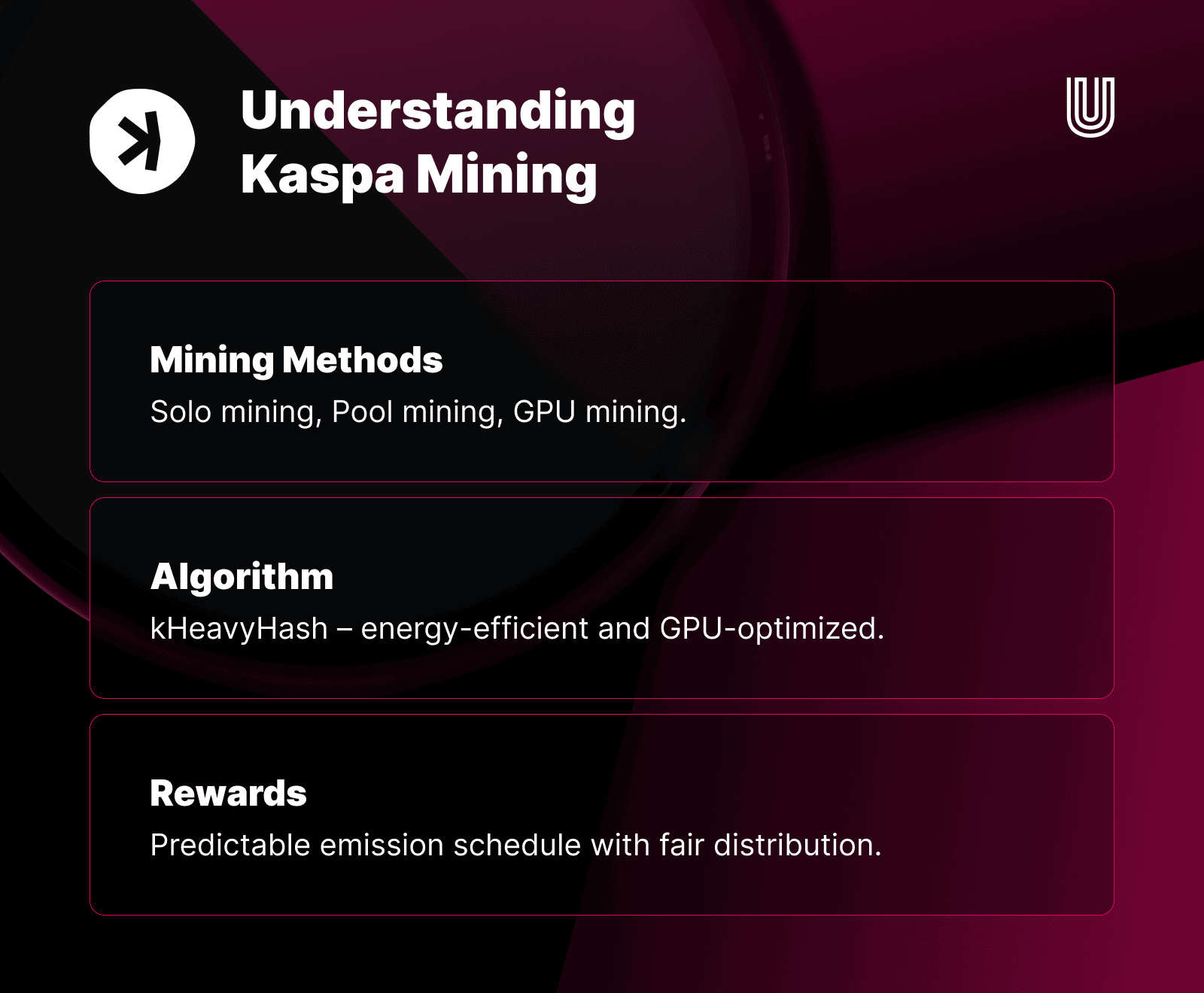
• Solo Mining: Miners can independently validate transactions and earn rewards without relying on third-party pools. Solo mining on Kaspa remains viable due to its efficient hashing algorithm.
• Pool Mining: Multiple miners combine their computational power to increase the chances of solving blocks and receiving rewards. This method ensures more consistent payouts, even for miners with limited hardware resources.
• GPU Mining: Kaspa’s kHeavyHash algorithm is optimized for GPU mining, allowing miners to efficiently participate using readily available hardware (source).
Kaspa’s approach ensures inclusivity, allowing both large-scale operations and independent miners to contribute meaningfully to the network.
Block Rewards and Incentives
Mining on Kaspa comes with a well-structured block reward system that balances incentives for miners with long-term network sustainability.
• Emission Schedule: Kaspa follows a gradual emission curve, ensuring that rewards are distributed predictably over time.
• Block Rewards: Miners are rewarded with KAS tokens for successfully adding valid blocks to the network.
• Decentralized Incentives: By supporting both solo and pool mining, Kaspa reduces centralization risks and ensures rewards are distributed fairly across participants (source).
Kaspa’s emission model avoids sudden drops in rewards, creating a predictable environment for miners to plan their operations effectively.
With efficient mining processes, fair reward distribution, and optimized GPU mining capabilities, Kaspa is an attractive option for both experienced miners and newcomers to proof-of-work systems.
Market Performance and Investment Potential
Kaspa has steadily gained attention from both retail investors and larger stakeholders, driven by its technical advantages, growing adoption, and increasing visibility across major exchanges. Its unique approach to scalability and transaction speed positions it as a strong contender in the competitive cryptocurrency market.
Market Trends and Growth
Kaspa’s market momentum has been fueled by both technological milestones and community support. Factors contributing to its growing market presence include:
• Exchange Listings: Kaspa (KAS) is now available on prominent exchanges, including Binance, which has significantly increased its liquidity and accessibility to global investors (source).
• Rising Trading Volume: The increasing activity around Kaspa tokens reflects growing investor confidence and market interest.
• Market Capitalization: Kaspa’s market cap continues to grow, reinforcing its position as one of the top-performing proof-of-work cryptocurrencies.
These indicators suggest sustained interest and the potential for further market expansion as adoption increases.
Investment Appeal
Kaspa’s core strengths make it appealing to both long-term investors and short-term traders:
• Strong Technical Foundation: Built on the GHOSTDAG protocol, Kaspa offers a solid infrastructure for real-world applications.
• Predictable Emission Model: The well-structured block reward system creates a transparent and predictable token distribution model.
• Utility and Use Cases: Kaspa’s speed, scalability, and low fees make it an ideal platform for micropayments, decentralized applications, and other blockchain-based solutions.
• Future Upgrades: Upcoming features like smart contracts and increased block rates add to its long-term potential.
For those looking to buy Kaspa (KAS), the token is available on multiple exchanges and can be stored in secure wallets, including Kaspa Web Wallet and hardware wallets like Tangem Wallets.
Risks to Consider
While Kaspa presents significant potential, investors need to remain aware of potential risks:
• Market Volatility: As with all cryptocurrencies, KAS is subject to price fluctuations.
• Regulatory Uncertainty: Local regulations around proof-of-work mining and cryptocurrency trading could impact Kaspa’s adoption.
• Technology Execution: Future upgrades, such as the integration of smart contracts, will require precise execution to meet expectations.
Kaspa’s combination of robust technical fundamentals, active development, and growing adoption creates an investment opportunity that balances potential rewards with manageable risks.
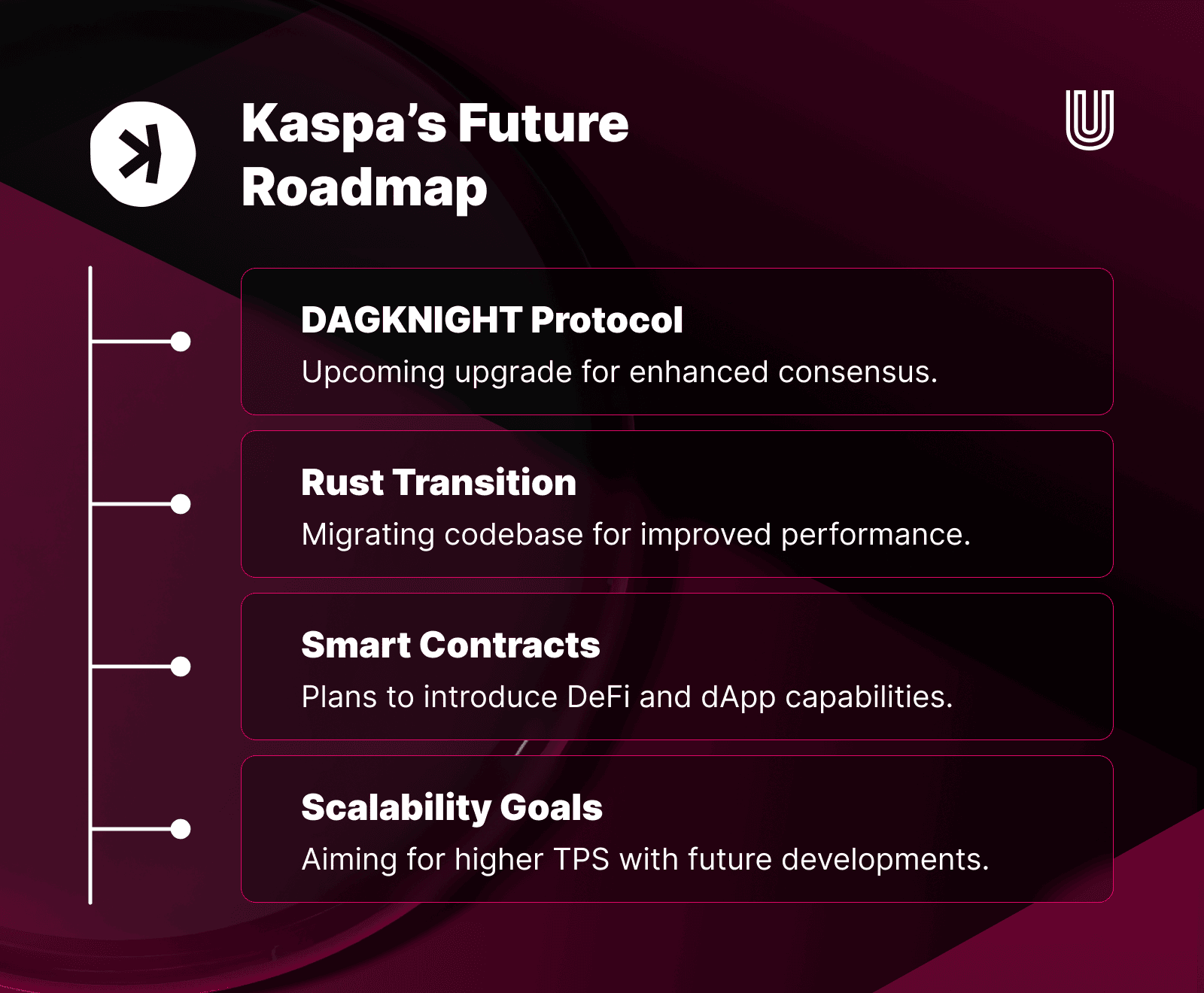
Future Roadmap and Developments
Kaspa has a clear roadmap focused on enhancing scalability, improving security, and introducing new functionalities to stay ahead in the cryptocurrency market.
DAGKNIGHT Protocol Upgrade
The upcoming DAGKNIGHT protocol aims to refine consensus mechanisms, improving both speed and network responsiveness. This upgrade targets throughput of over 100 blocks per second while maintaining security and decentralization.
The transition from Golang to Rust
Kaspa is migrating its core codebase from Golang to Rust to improve performance, reduce latency, and optimize resource usage. Rust’s efficiency and developer adoption will ensure better long-term sustainability.
Smart Contracts and Layer-2 Solutions
Plans include enabling smart contracts to support DeFi applications and decentralized apps (dApps). Layer-2 solutions are also on the horizon for advanced scalability.
Increased Block Generation Rates
Kaspa aims to increase its block generation rate to 32 blocks per second, with long-term goals exceeding 100 blocks per second, ensuring near-instant transaction confirmations.
Archival Node Improvements
Planned upgrades to archival nodes will enable faster access to historical blockchain data, supporting analytics and transparency.
Ecosystem and Community Growth
Efforts include developer grants, ambassador programs, and exchange partnerships to boost adoption and global reach.
Kaspa’s roadmap highlights a strategic focus on performance, scalability, and utility, setting the stage for long-term growth and innovation.
Kaspa Crypto: Pioneering the Future of Blockchain Scalability
Kaspa offers a technically advanced approach to addressing the core challenges of speed, scalability, and security in proof-of-work systems. Through innovations like the GHOSTDAG protocol, kHeavyHash algorithm, and a clear focus on decentralization, Kaspa stands out as a network capable of supporting real-world applications and high-frequency transactions.
With an ambitious roadmap featuring DAGKNIGHT, Rust migration, and smart contracts, Kaspa is well-positioned to become a key player in blockchain technology’s next chapter. Whether for developers, miners, or investors, Kaspa represents a network built not just to compete but to lead.
Frequently asked questions
What is Kaspa Crypto and how does it work?
Kaspa is a proof-of-work (PoW) cryptocurrency designed for high transaction speed and scalability. It uses the GHOSTDAG protocol, allowing parallel block creation instead of a linear chain, enabling multiple blocks to coexist and be validated simultaneously. This results in faster transactions, reduced congestion, and increased throughput without compromising decentralization or security.
How fast are Kaspa transactions per second?
Kaspa currently processes up to 10 blocks per second, with future upgrades aiming to reach 32 blocks per second and potentially 100 blocks per second. Thanks to its blockDAG structure, Kaspa can handle a high volume of transactions efficiently, making it suitable for micropayments and large-scale decentralized applications.
Is Kaspa a good investment for the future?
Kaspa stands out with its innovative GHOSTDAG protocol, kHeavyHash algorithm, and a well-defined future roadmap focused on scalability and smart contracts. Its growing ecosystem, increasing adoption, and listing on major exchanges suggest strong potential for long-term growth. However, like all cryptocurrencies, it carries market risks, so thorough research is essential before investing.