In the healthcare industry, every click can carry clinical weight and every data point must be treated like patient care. Behind every digital product for hospitals, clinics, or patients lies a silent engine: analytics. You need actionable insights to understand how people interact with your platform, what slows them down, where they drop off, and what drives engagement. But here’s the catch - in healthcare, you’re not just tracking clicks or scroll depth. You’re dealing with highly sensitive public health data governed by regulations like HIPAA, GDPR, and CCPA.
And that’s where things get tricky. Many popular analytics tools, like Google Analytics, just aren’t built for this level of responsibility. They collect too much, store data in ways that raise red flags, and often lack the controls health-focused products require.
So what’s the alternative?
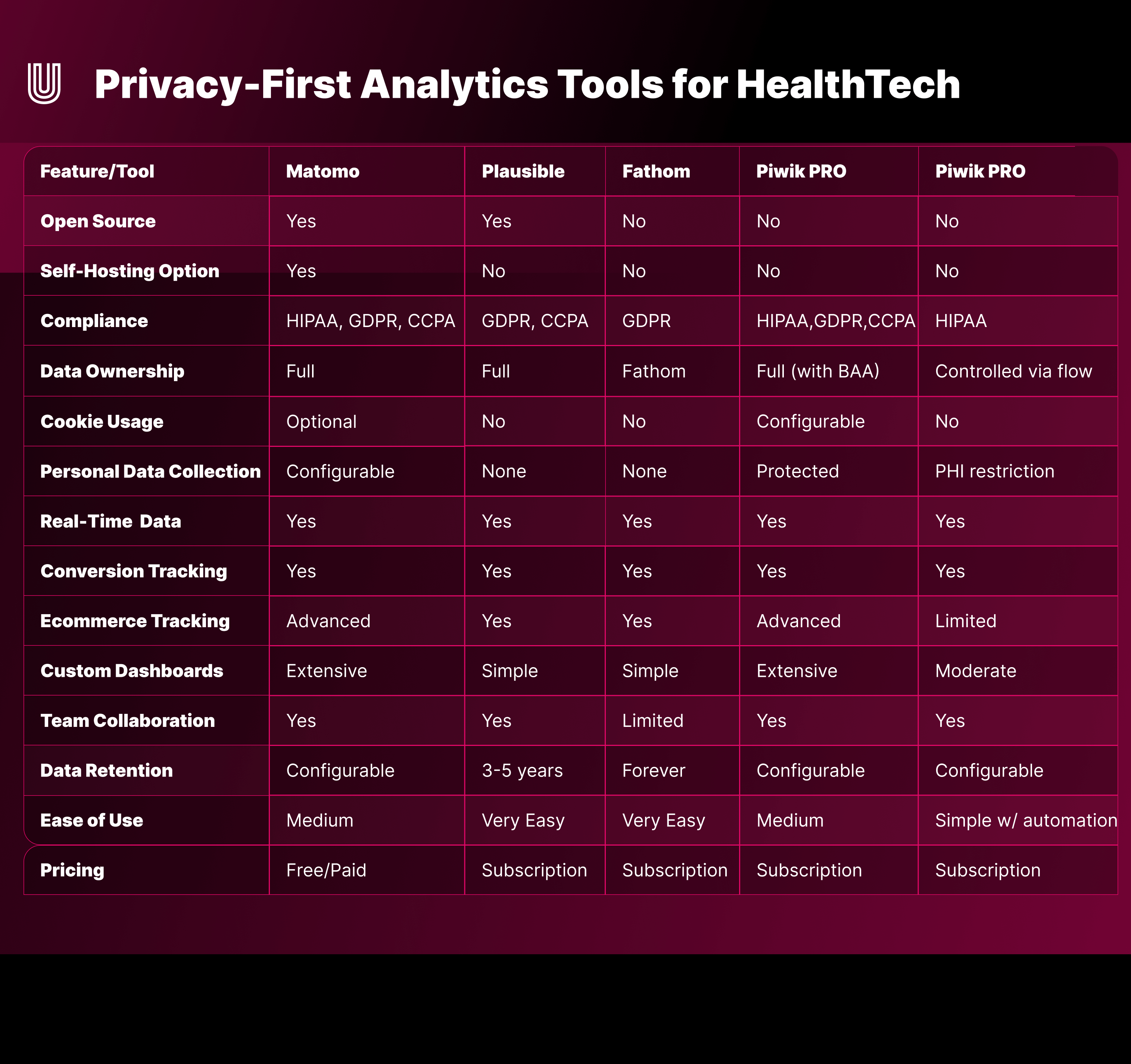
In this article, we compare privacy-first analytics solutions that allow healthtech and medtech teams to collect the data they need without compromising compliance.
Matomo: Full Control, Full Transparency in Data Analytics in Healthcare
Matomo is an open-source powerhouse trusted by privacy-sensitive sectors, including the healthcare industry, which generates and utilizes vast amounts of data. Its commitment to data ownership, on-premise hosting, and broad configurability makes it a top choice for teams that want deep and valuable insights without third-party involvement, while efficiently managing the large volume of data generated by healthcare organizations.
Key Benefits:
- Self-hosting for full data control and secure, flexible data storage options
- Configurable to comply with HIPAA, GDPR, and CCPA
- Extensive reports and goal/ecommerce tracking
- Option to operate cookie-free
- No user consent required (depending on setup)
Best for: Teams needing enterprise-level features with maximum control and customization.
Matomo meets all our needs. It’s transparent, self-hosted and open source. It provides us evidence that data from the very beginning, to the very end do not escape our clients ecosystem.
 Mateusz PydychFullstack Developer at ULAM LABS
Plausible: Lightweight and Privacy-First
Plausible Analytics is a simple, cookie-free, open-source alternative. It delivers clean, understandable metrics without invasive tracking or consent banners, helping healthcare organizations stay lean and compliant. Plausible also enables secure management of health data and facilitates compliant data sharing between teams.
Key Benefits:
- No cookies or personal data
- Real-time dashboard and scroll-depth tracking
- Easy UTM and funnel tracking
- Built-in team collaboration
- Not on-premise, but hosted in the EU with a strong focus on privacy and regulatory alignment
Best for: Startups and small teams needing basic insights with zero privacy risk.
Fathom: Real-Time Simplicity, Cookie-Free Actionable Insights
Fathom Analytics focuses on usability, speed, and data security. With a clutter-free dashboard and instant filtering, it’s great for fast-moving product teams who still want full privacy compliance.
Key Benefits:
- GDPR-compliant with no personal data
- Real-time metrics and custom events
- Lifetime data retention
- Clean interface with a flat learning curve
- Effective data visualization tools that transform complex healthcare data into actionable insights
Best for: Teams that prioritize speed and simplicity while respecting privacy.
Piwik PRO: Enterprise-Grade, HIPAA-Compliant
Piwik PRO is tailored for large-scale healthcare use. It offers HIPAA-certified hosting, audit logs, and encryption, alongside a full suite of analytics, tag management, and CDP tools. It enables healthcare organizations to securely analyze electronic health records, clinical data, and claims data to support advanced healthcare analytics and compliance.
Key Benefits:
- HIPAA, GDPR, and CCPA compliance
- Business Associate Agreements (BAAs)
- Secure infrastructure with full data control
- Server-side tagging and advanced reports
- Familiar UI for Google Analytics users
- Supports tracking clinical outcomes and key performance indicators for hospitals and healthtech platforms
Best for: Hospitals, medtech platforms, and enterprise healthtech environments . where self-hosting is not a strict requirement.
For medtech applications with on-prem or air-gapped infrastructure requirements, the lack of full self-hosting may be a blocker.
Freshpaint: HIPAA-Compliant Patient Data Security Infrastructure
Freshpaint acts as a privacy firewall for your data. It automates HIPAA-compliant event tracking and integrates safely with tools like Google Ads and Facebook Pixel—without exposing PHI.
Key Benefits:
- Automatically restricts PHI from flowing to third parties
- Codeless event tracking
- Supports compliant ad campaigns
- Infrastructure-level data control
- Enables data driven decision making for healthcare marketers by providing actionable insights from diverse data sources
- Built specifically for healthcare marketers
Best for: Healthcare providers and marketers who need automation and secure data management.
What Makes a Healthcare Data Analytics Tool Compliant? Key Features to Look For
Not all analytics platforms are created equal, especially when it comes to healthcare and medtech, where handling sensitive data comes with legal obligations.
When evaluating analytics tools for compliance with regulations like HIPAA, GDPR, or CCPA, here are the must-have features to look for:
- Data Anonymization & Masking
The ability to anonymize or pseudonymize personal data (e.g. IP addresses) ensures that sensitive information can’t be traced back to individuals.
“In healthcare, anonymization is non-negotiable — and it has to happen before the data ever leaves your infrastructure.
If an analytics tool anonymizes data server-side, that’s often too late from a compliance standpoint.
That’s why we always recommend self-hosted tools with client-side anonymization. Anything else? Only if your legal team explicitly signs off — and that’s rarely the case in medtech.”
- Mateusz Pydych, Team Lead & Full stack Developer.\
- No Cookies or Consent-Free Tracking
Some tools operate entirely without cookies, reducing the need for consent banners and simplifying GDPR/PECR compliance.
- Data Ownership & Hosting Flexibility
Platforms that allow self-hosting or offer full data ownership help ensure that your data doesn’t leave secure environments or third-party jurisdictions.
- Business Associate Agreements (BAAs)
For HIPAA compliance, vendors must be willing to sign a BAA and provide clear policies for handling Protected Health Information (PHI).
- Granular Consent Management
Built-in tools to manage, log, and honor user consent preferences across geographies and legal frameworks.
- Audit Logs & Access Controls
Clear records of who accessed what data and when, combined with robust user permission settings, are essential for security audits. Managing and interpreting audit data requires technical skills and data science expertise, especially for healthcare data analysts.
- Server-Side & First-Party Tracking
These reduce third-party dependencies and improve control over data flows—key for compliance and performance.
- Retention Policies & Data Portability
Ability to set how long data is kept, delete it on request, or export it in line with regulatory requirements like GDPR’s Right to Be Forgotten.
While some tools (like Plausible) are designed with privacy in mind and are EU-hosted, they do not offer self-hosting out of the box, which may be a critical requirement for some healthtech platforms. If your compliance strategy requires full on-premise deployment, this is a key consideration.
Conclusion
Choosing the right healthcare analytics platform is never a purely technical decision but rather a mix of compliance, data governance, infrastructure, and internal legal policies.
For us at ULAM LABS, Matomo stands out as the most reliable and flexible choice for healthtech projects. It’s self-hosted, privacy-first, and aligns with the strict compliance requirements we often encounter in MedTech and hospital environments.
That said, every organization has its own risk appetite and legal framework. While some may opt for hosted solutions under strict BAAs and internal audits, we strongly recommend evaluating whether keeping full control over your data from anonymization to storage isn’t the safer, long-term route.
Need Help Choosing or Implementing the Right Analytics Stack?
ULAM LABS is among top healthcare IT consulting companies. We build healthtech software with compliance, privacy, and performance in mind. Whether you're developing a medical platform, patient-facing app, or complex backend for a healthcare provider, we’ll help you choose and implement the right tools for analytics, infrastructure, and beyond.
Let’s talk about your project and how we can build something secure, scalable, and smart from day one.