Every founder building an MVP in a regulated space hits the same question sooner or later: do we need SOC 2, ISO 27001 or a GDPR programme before we've even proven anyone wants the product? Get it wrong in one direction and you spend six figures and a year of runway on audits for a product that may pivot twice. Get it wrong in the other and your first serious customer sends a 300-question security questionnaire you can't answer, or worse, you end up rebuilding the data layer because nobody thought about where patient data lives. These three are not the same kind of obligation, and treating them as one checklist is where most MVP teams go wrong.
The short answer
GDPR: yes, from day one if you process personal data of people in the EU or UK. It is a legal obligation, not a certificate.
SOC 2: usually not yet. It is a voluntary audit report that US enterprise buyers ask for. Start it when a real deal depends on it, not before.
ISO 27001: usually not yet, for the same reason, but it carries more weight than SOC 2 with European and UK buyers.
ISO 13485: it depends on what you're building. If your software is a medical device, a quality management system is part of the regulatory path.
Advice
What every MVP does need is an architecture that won't block any of these later. That part is cheap now and expensive in 18 months.
GDPR: not optional, even for an MVP
GDPR has no "beta" exemption. The moment your MVP collects an email address, a login or a symptom from someone in the EU, you are a data controller with obligations. The UK GDPR works the same way for UK users.
The stakes are higher in health. Under Article 9, health data is a special category that needs an additional legal basis and stronger safeguards. The upper fine tier reaches EUR 20 million or 4% of global annual turnover, whichever is higher. For an early startup, though, the realistic risk is less a headline fine and more a failed due diligence or a hospital procurement team that won't sign.
The good news: GDPR compliance for an MVP is mostly about decisions, not paperwork.
The minimum looks like this:
- Know your data- a simple record of what personal data you collect, why, where it's stored and who can access it
- Pick a lawful basis for each purpose, and an Article 9 condition if you touch health data (explicit consent is common at MVP stage)
- Collect less because every field you don't store is a field you never have to protect, export or delete
- Choose EU/UK hosting or document your international transfers properly. For NHS work, UK data residency is the safe default (our approach to cloud infrastructure for medtech)
- Sign DPAs with your cloud provider, analytics, email and any other processor
- Build for user rights: access, export and deletion should be a function in your code, not a manual database query
- Run a DPIA if you process health data at scale or use it in new ways. For most digital health products, you will
- Have a breach plan. Breaches must be reported to the regulator within 72 hours
SOC 2: a sales tool, not a legal requirement
No law requires SOC 2. It is an attestation report from an independent auditor, built around the AICPA Trust Services Criteria, and it exists because US enterprise buyers want proof that a vendor handles data responsibly. Despite how press releases describe it, it is a report, not a certification.
There are two types:
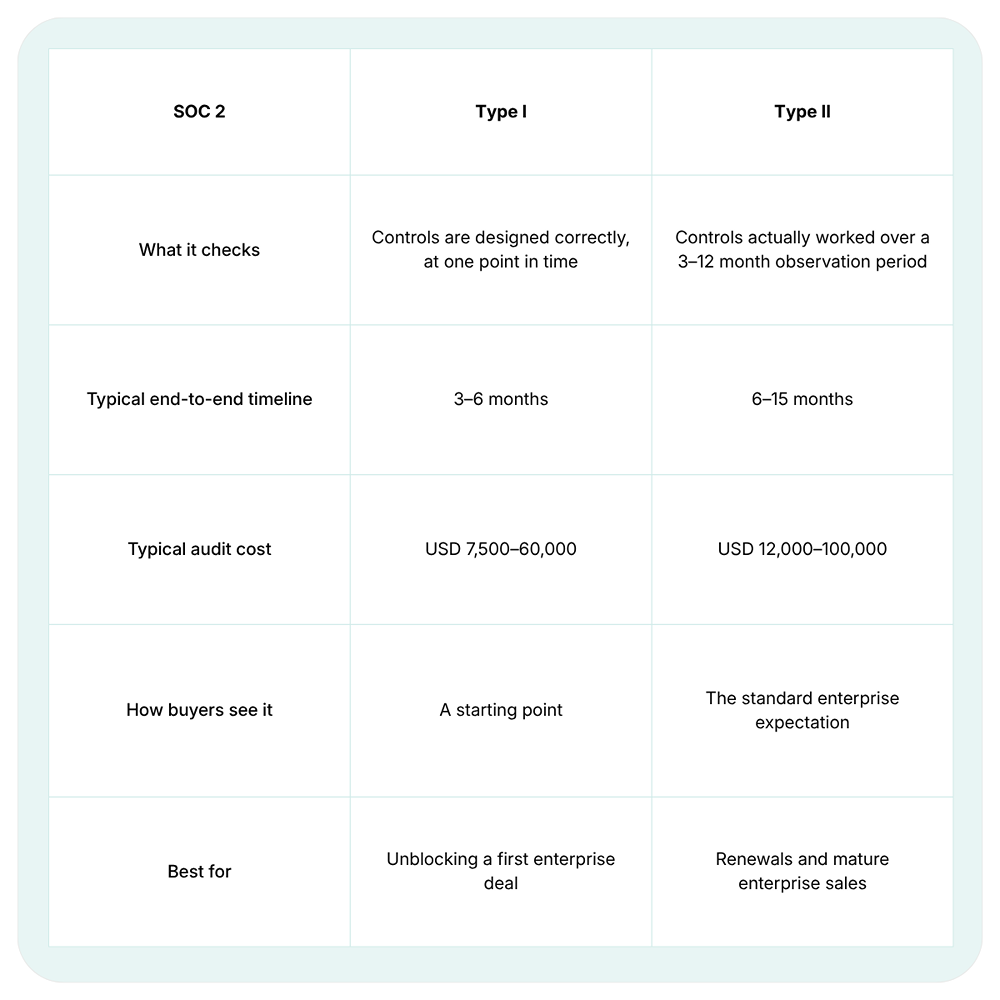
Ranges from Drata. They cover the audit only: readiness work, compliance automation tools and your team's time come on top.
When it becomes worth it: when a specific deal, usually with a US enterprise or health system, is blocked on it. For many teams that happens around Series A. Before that, a clear security overview and honest answers to questionnaires usually get you further than a half-finished audit.
ISO 27001 vs ISO 13485: two different questions
These two standards get lumped together because they share the "ISO" label, but they answer different questions.
ISO 27001 asks: is your information secure? It certifies an information security management system (ISMS). Like SOC 2, it's voluntary and market-driven, but it's the format European and UK buyers recognise. For a small organisation, Consilien estimates USD 15,000–50,000 in year one, USD 10,000–25,000 a year to maintain, and 6–10 months to get there (Consilien). The controls overlap heavily with SOC 2, so if you'll eventually need both, plan them in sequence rather than as two separate projects.
ISO 13485 asks: can you reliably build a safe medical device? It's a quality management system standard for medical device manufacturers. If your product is Software as a Medical Device, this is not a nice-to-have badge. Under the EU MDR and UK MDR, a QMS is part of getting a CE or UKCA mark for most device classes. In the US, the FDA's Quality Management System Regulation, in force since 2 February 2026, incorporates ISO 13485
by reference. Certification to ISO 13485 isn't strictly required for FDA compliance, but conforming to it is.The practical consequence: if you're building SaMD, design controls, risk management and traceability from requirements to tests need to start with the MVP. Retrofitting a design history file onto code written without one is one of the most expensive mistakes in medtech.
Healthcare changes the rules
If your MVP touches patient data or clinical decisions, a few more frameworks come into play, and some of them are not optional. For a stage-by-stage view, see our guide to compliance across the healthtech product lifecycle.
-
HIPAA (US). Applies if you are a covered entity or a business associate handling protected health information for one. There's no official HIPAA certification, so be wary of anyone selling one. What you need are safeguards, signed Business Associate Agreements and documented risk analysis.
-
EU MDR / UK MDR / FDA. If your software diagnoses, predicts, monitors or informs treatment decisions, it may be a medical device. Under MDR Rule 11, much decision-support software lands in class IIa or higher, which means a notified body and a QMS. Work out your intended purpose and classification before you write the MVP spec, because that wording decides your regulatory path.
-
NHS DTAC (England). The Digital Technology Assessment Criteria cover clinical safety, data protection, technical security, interoperability, and usability and accessibility. NHS England refreshed the form in 2026, and the new version replaced the old one from 6 April 2026. Technical security expectations include Cyber Essentials, penetration testing and multi-factor authentication. If the NHS is your market, DTAC is effectively your compliance checklist, and you'll also meet the DSPT and the DCB0129 clinical safety standard along the way.
None of these require a finished certificate on day one, but each sets requirements your MVP's architecture has to meet. More on that below.
What you need, and when
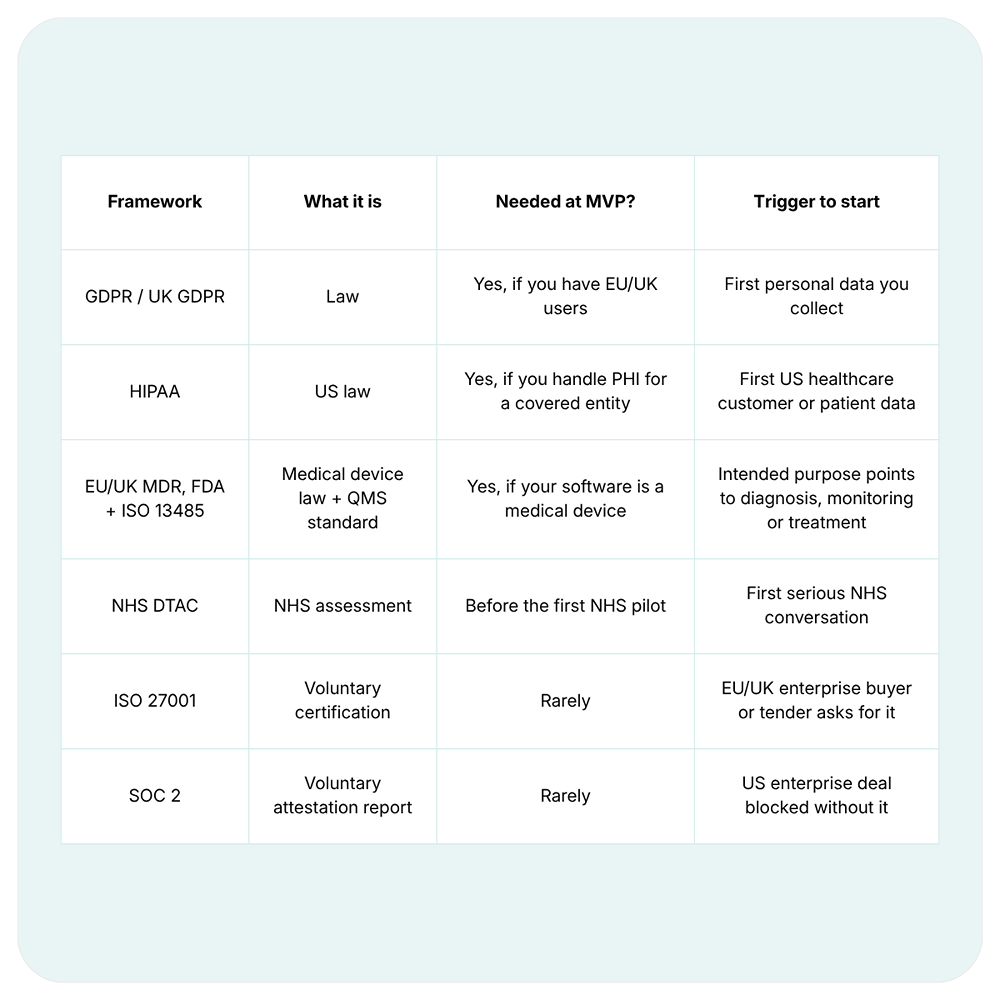 Laws apply from your first user. Voluntary certifications follow revenue.
Build it in now, certify it later
You don't need an auditor for your MVP. Most SOC 2 and ISO 27001 controls are things a well-run engineering team does anyway; the difference is whether you can prove it. These ten decisions make that proof a by-product of how the system is built:
- Separate environments. Production data never lives in dev or staging. Use synthetic or anonymised test data from the start.
- Identity and access from day one. SSO and MFA for the team, role-based access in the product, no shared admin accounts.
- Audit logging. Log who accessed or changed sensitive data, and keep those logs somewhere they can't be quietly edited.
- Encryption by default. At rest and in transit, with keys managed by your cloud provider's KMS rather than in a config file.
- Infrastructure as code. If your infrastructure is in Terraform or similar, a large part of your evidence already exists.
- Isolate sensitive data. Keep health or identifiable data in a clearly bounded store, so the scope of any future audit stays small.
- Change management in your pipeline. Pull requests, code review and CI checks give you a change history auditors accept, without extra process.
- Data subject rights as features. Export and delete endpoints, plus retention rules enforced in code.
- A vendor list. Every third-party service that touches user data, with its DPA and hosting region.
- Traceability, if you're SaMD. Link requirements, risks, code and tests from the first sprint.
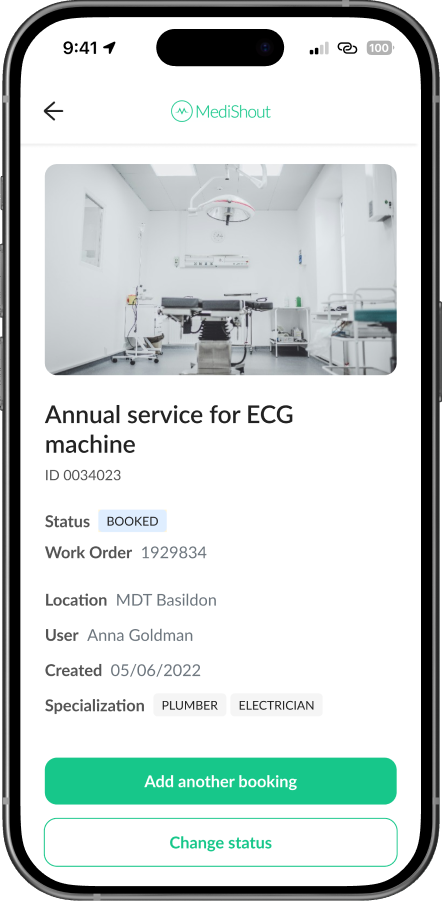
We took this approach with a UK healthtech startup and delivered a DSPT- and GDPR-compliant, NHS-ready MVP in 2 months, with a team of one engineer and one QA. It's the same principle behind our long-term work with MediShout, now used in over 200 hospitals.
The bottom line
For most MVPs, the answer is: comply with the law now, certify when the market asks, and architect as if you'll be audited next year. GDPR, and HIPAA or medical device rules where they apply, are not negotiable at any stage. SOC 2 and ISO 27001 are investments you make when a deal justifies them.
The teams that struggle aren't the ones that skipped SOC 2 at seed stage. They're the ones whose MVP architecture made every later certification a rebuild.
At Ulam Labs we're a technology partner for medtech and digital health teams at exactly this stage: scoping what actually applies to your product and building the MVP so later compliance work is evidence-gathering, not rework. If you're weighing these decisions now, we're happy to talk them through.
We help Medtech and Healthtech teams build pilots, propotypes and MVPs
This article is general guidance, not legal advice. Your obligations depend on your product's intended purpose, your markets and the data you process.
Frequently asked questions
Do I need SOC 2 before launching my startup?
No. SOC 2 is not legally required at any stage. Get it when a customer, typically a US enterprise or health system, makes it a condition of the contract. Until then, document your security practices so you can answer questionnaires credibly.
Is GDPR compliance mandatory for an MVP or beta?
Yes, if you process personal data of people in the EU or UK. There is no exemption for prototypes, pilots or free products. Small companies have some lighter record-keeping duties, but those rarely apply once you process health data.
What's the difference between SOC 2 and ISO 27001?
Both show that you manage information security well. SOC 2 is an auditor's report on your controls, common in the US. ISO 27001 is a certification of your security management system, preferred in Europe, the UK and public-sector tenders. Many of the controls overlap, so the second one is much cheaper once you have the first.
Can I get SOC 2 and ISO 27001 at the same time?
You can, but most startups do one first, based on where their first enterprise customers are, and map the controls to the other later.
Is there such a thing as a HIPAA certification?
No. The US government doesn't certify HIPAA compliance. Third-party "HIPAA certified" badges are marketing, not a legal status. What matters is your safeguards, risk analysis and Business Associate Agreements.
Does my health app count as a medical device?
It depends on its intended purpose. Apps for general wellness, scheduling or admin usually don't. Software that diagnoses, predicts, monitors a condition or supports treatment decisions often does. Decide this before you write the MVP spec, ideally with a regulatory consultant.
Do I need ISO 13485 for an MVP?
Only if your software is a medical device. In that case you don't need the certificate on day one, but you need the processes it describes, especially design controls and risk management, from your first sprint.
What does the NHS require from a digital health supplier?
In England, expect a DTAC assessment, a DSPT submission, clinical safety documentation under DCB0129, Cyber Essentials and a recent penetration test. A medical device also needs UKCA or CE marking.
When should a startup start thinking about compliance?
Before writing code. Not because you need certificates early, but because the cheapest moment to make compliance-friendly architecture decisions is before the architecture exists. Our free security and compliance ebook for medtech founders goes deeper on this.